
Aztec — 2025
NoirCon: A Three-Act Developer Conference
How I built a single-day gathering into a three-city conference series, learned the hard way what the audience actually wanted, and pivoted to the format that broke through: a pure workshop day that sold out Devconnect.
developer relations · events · conference · zk
The Context
In late 2024, Noir was one of Web3’s fastest-growing developer ecosystems, a ZK programming language that made privacy-preserving applications dramatically easier to build. My job at Aztec was to turn that momentum into a community. The playbook I had was events. The playbook I didn’t have was any good way to know what a Noir developer conference should actually look like.
So I built it three times. Each version was a deliberate bet on a different answer to the same question: what do developers in a new ecosystem actually come to events for?
NoirCon 1: Denver (ETHDenver 2025)
~150 attendees · Speaker-driven · AI × ZK theme
NoirCon 1: Privacy, AI, and App Building.
View the event page on Lu.ma
The first NoirCon was, honestly, a “will anyone show up?” bet. We had just come off NoirCon 0 in Bangkok, a half-day gathering with Vitalik and a handful of researchers, and I wanted to see if we could stand up something of our own in Denver without borrowing someone else’s stage.
The programming was speaker-heavy and thematically loose. We leaned into the AI meets ZK angle because it was what the ecosystem was talking about, and we landed Ilya Polosukhin (founder of Near AI, co-author of the original transformer paper) alongside technical deep-dives on privacy-preserving agents and zkDSLs vs zkVMs. The venue was Catalyst in RiNo, a two-floor space that gave us a main stage, a workshop room, and a rooftop for networking.
What worked: the intimacy. 150 people self-selected into a room full of privacy engineers, and conversations were dense. The AI × ZK framing got us picked up by media outlets and pulled in speakers who wouldn’t have come for a protocol-only pitch.
What I read from the room: the single loudest piece of feedback wasn’t about any talk, it was about the workshops. Every workshop session I ran capped out, and attendees asked for more. People showed up wanting to build, not just listen.
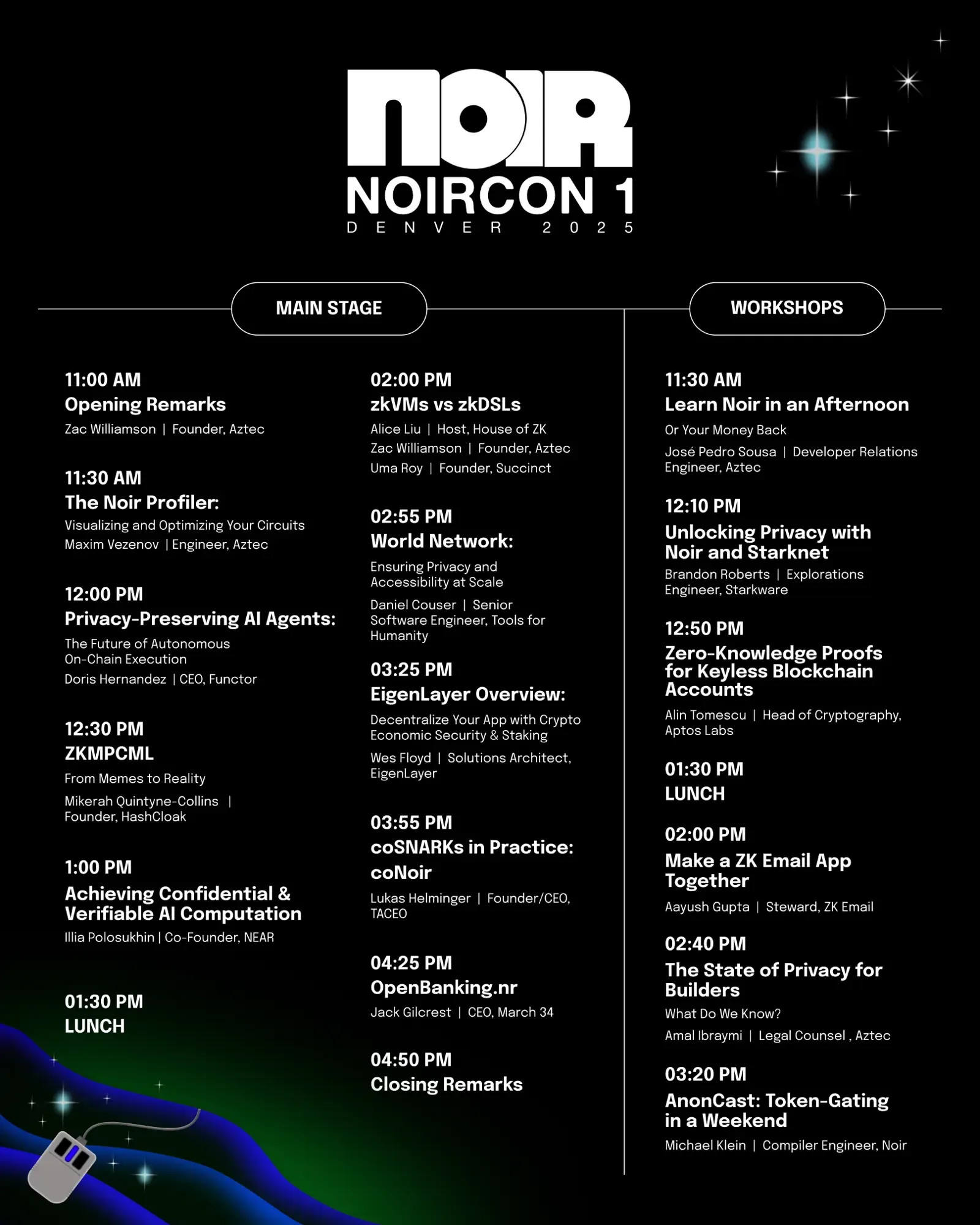
The NoirCon 1 programming schedule.
NoirCon 2: Berlin (Berlin Blockchain Week 2025)
392 attendees · Split format · The lesson I needed
NoirCon 2: Building Privacy Apps People Will Use
View the event page on Lu.ma
For the second event I tried to split the difference. I still wanted the prestige and reach of a main-stage conference, we had landed a talk lineup that included Zac Williamson’s opening keynote, an Oxford-style debate between Aztec and StarkWare, a panel on investing in private infrastructure, and a fireside chat with Judith de Boers (the Dutch defense attorney on the Tornado Cash case). At the same time, I wanted to honor what Denver had told me: more hands-on building.
So I built Berlin as a single-track main stage with two parallel workshop rooms running all day, nine workshops in total, covering everything from “Learn Noir in an Afternoon” to ZKPassport’s identity verification to TACEO’s coSNARK-powered MPC card shuffling. On paper, best of both worlds.
What went wrong: workshop capacity. Every workshop filled. Then overflowed. Then people started leaving rooms, frustrated, because we were turning them away. The feedback after the event was consistent and pointed: you built two workshop rooms in an event where the demand was for five, and the main stage, while well-produced, was the thing people were willing to skip. When I talked about this later in a job interview, I described it as “trying to split the difference.” That’s exactly what it was, and that’s exactly why it didn’t work.
The lesson, and the systemic change: the audience had already told me what they wanted in Denver, and I had hedged against it in Berlin. The format wasn’t going to get fixed by adding one more workshop room. It was going to get fixed by deleting the conference half of the conference.
NoirCon 3: Buenos Aires (Devconnect 2025)
400+ builders · Workshop-only · Three parallel tracks
NoirCon 3: For privacy developers
View the event page on Lu.ma
For the third event I made the bet Berlin had been telling me to make. We killed the main-stage conference entirely. No panels. No debates. One fireside chat, Joe Andrews and Claire Kart, 30 minutes, because it was the one piece of narrative framing the day needed, and otherwise, nothing but workshops.
The structure was three parallel tracks running in the same building as Devconnect, inside La Rural’s Red Pavilion in Palermo:
- Noir track — the fastest-growing ZK language, taught from first principles through production-ready library design, with workshops from Stellar, TACEO, Mopro, and PSE.
- Aztec track — the most advanced collection of Aztec workshops ever assembled: protocol architecture, local setup, writing your first private contract, ZKPassport’s FaceMatch internals.
- Privacy Community track (curated with the Ethereum Foundation) — Ethereum’s privacy roadmap, MPC in practice, verifiable randomness, and a Zashi/Zcash session from an Electric Coin Company board member.
The shape of the day was simple on purpose: 10am, write your first proof. Noon, debug your tenth. 2pm, office hours with Noir and Aztec engineers. 4pm, leave with working code. We were explicit about it in the copy, “leave with working code and dangerous ambitions,” because I wanted people to know before they showed up that this was a build day, not a watch day.
What happened: it sold out. 400+ builders packed the Ceibo Rooms. Every track was full. The Noir 1.0 announcement, our first major release, landed from the workshop room instead of a keynote stage, and it was more credible because of it. Aztec’s post-event recap called it “privacy at the center of Devconnect.” It became, in one year, the key ZK developer conference on the calendar.
The Arc, In One Sentence
Denver taught me what the audience actually wanted. Berlin taught me what happens when you hedge. Buenos Aires was what you get when you stop hedging.
Key Learnings
- The audience tells you the format. A developer conference is not a speaker showcase with workshops bolted on. It’s a build day with as much framing as you need and no more.
- Hedging is the expensive mistake. Berlin cost more than Buenos Aires and delivered less, because I tried to keep the conference shape I already knew how to produce. The cheaper event with the sharper format worked better.
- Product-led programming beats talk-led programming. Announcing Noir 1.0 from a workshop room, where the audience was already writing Noir, was more credible than a keynote ever would have been. The medium was the message.
- Iterating in public builds credibility. Each event sold the next one. Denver got us Berlin’s speakers. Berlin’s shortcomings, acknowledged publicly, got us buy-in for Buenos Aires’ radical format shift. The series itself became a track record.
- Working closely with the engineering team is the multiplier. Every workshop at NoirCon 3 was led by an Aztec or ecosystem engineer I’d spent weeks preparing alongside. The conference format scaled because the engineer-to-attendee ratio was, by design, absurd.
What started as a half-day room in Bangkok ended the year as a sold-out Devconnect anchor event. The series didn’t get there by being bigger each time, it got there by being sharper each time.